


Walk into any home that was built in the ’80s and you can usually tell — harvest gold appliances, oak cabinets with brass pulls, maybe a wallpaper border near the ceiling. It screams a specific decade. Now imagine walking into a kitchen in 2045 and having that same feeling about your renovation today.
That’s the nightmare timeless kitchen design was built to prevent.
Whether you’re scrolling through kitchen ideas images on a lazy Sunday or seriously planning a full remodel, this guide gives you the real insider tricks that professional designers use to create kitchens that look just as good 30 years from now as they do today. No fads. No regrets. Just smart, lasting design choices you’ll love every single morning.
Here’s what you’ll learn: the exact principles behind timeless kitchen design, which modern style kitchen design elements are safe bets versus risky trends, and how to make bold moves without dating your space.
What Makes a Kitchen Design Truly “Timeless”?
Before diving into the tricks, it helps to understand what timeless kitchen design actually means. It’s not about playing it safe or going boring. It’s about choosing elements that have proven staying power — design choices that were loved 20 years ago, are loved today, and will still feel fresh 20 years from now.
The best timeless kitchen design hits three marks: classic proportions, neutral but rich materials, and functional layouts that adapt to how people actually live. When you look at pictures of kitchen designs that have aged gracefully, you’ll notice they rarely chase a single trend. Instead, they build on an aesthetic foundation that allows small updates — new hardware, a fresh coat of paint, updated lighting — without requiring a gut renovation every decade.
Think of timeless kitchen design as a long-term investment. You’re not designing for Instagram right now. You’re designing for your life.
Trick #1: Anchor Your Kitchen With a Neutral Palette (Then Add Personality in Layers)
Color is the fastest path to dating a kitchen. Millennial pink, avocado green, cobalt blue cabinets — each had their moment, and each became a renovation regret for thousands of homeowners.
The core rule of timeless kitchen design: go neutral on the big permanent surfaces, then inject personality through items you can swap out.
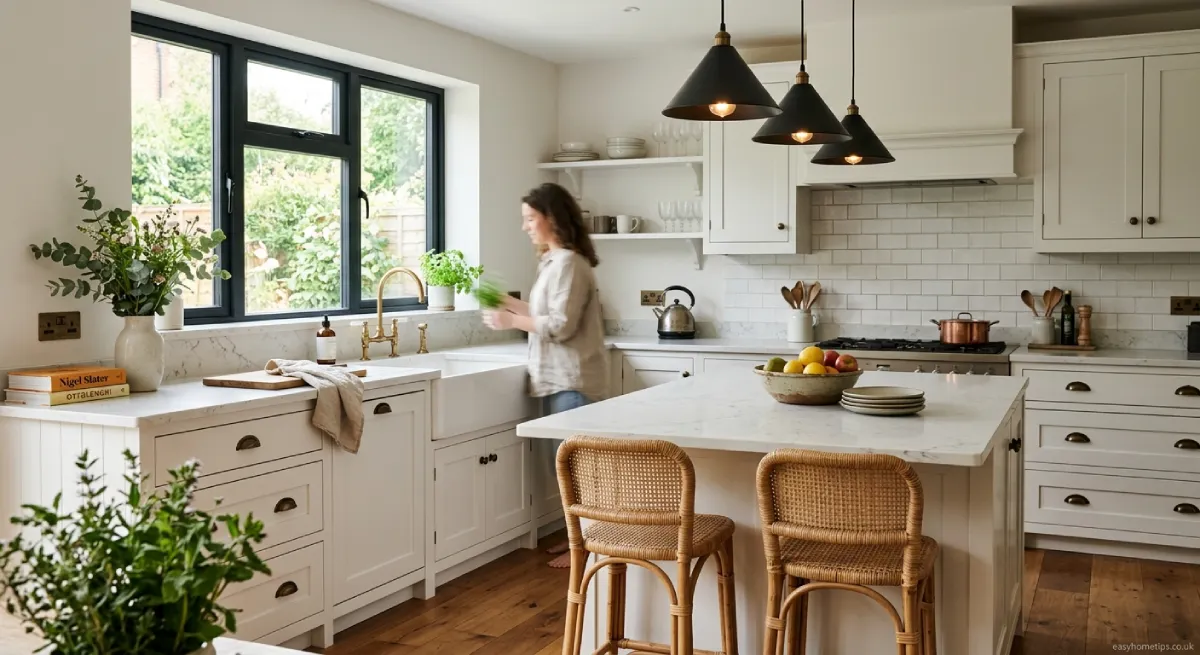
White, off-white, warm greige, and soft sage are the proven winners. But “neutral” doesn’t mean sterile. The trick is layering texture and tone within your neutral palette. Think matte white uppers with a slightly warmer shaker lower cabinet, or a creamy quartz countertop against warm wood-toned flooring. The contrast creates visual richness without committing to anything polarizing.
Where do you add personality? Barstools, pendant lights, small appliances, cabinet hardware, dish towels, even a statement rug. These are low-cost swaps you can make in an afternoon. Kitchen design ideas that build in this flexibility are the ones you never get tired of.
Trick #2: Choose Cabinet Styles That Have Already Proven Themselves
Here’s something designers know that most homeowners don’t: if a cabinet style has been around for at least 50 years without going out of fashion, it’s earned the “timeless” label.
Shaker cabinets are the gold standard of timeless kitchen design. Their clean, recessed panel construction originated in the 18th century and has never lost favor. They work in farmhouse kitchens, modern style kitchen design, transitional spaces, and even contemporary urban lofts. That versatility is exactly what timeless design is all about.
Flat-panel (slab) cabinets are a close second — they’re clean, simple, and have been a staple of modern European kitchen design for decades. They photograph beautifully, which is part of why so many kitchen ideas images feature them, but they’ve also proven themselves in real homes over time.
What to avoid: heavy ornamental detailing, ultra-chunky crown molding, and anything that requires a specific aesthetic to look right. If a cabinet style can only work with one look, it’s a trend, not a classic.
Trick #3: Invest in Stone Countertops — the Right Ones
Countertops are one of the highest-touch, most-visible surfaces in your kitchen. Getting this right is central to any timeless kitchen design strategy.
Natural stone — marble, granite, quartzite — has been used in homes for centuries. That’s about as timeless as it gets. But not all natural stone is equal for kitchen use. Here’s the honest breakdown:
Marble is gorgeous but porous and prone to etching from acids like lemon juice or vinegar. If you cook heavily, it will show it. That said, a well-worn marble countertop carries a patina that many designers consider beautiful in its own right.
Quartzite (not to be confused with engineered quartz) offers the look of marble with better durability. It’s a strong choice for timeless kitchen design in active households.
Engineered Quartz (brands like Caesarstone or Cambria) combines durability with design flexibility. High-quality quartz in classic veined or solid patterns looks just as good as natural stone in most pictures of kitchen designs, and it’s virtually maintenance-free.
The pattern matters too. Stick to classic veining or subtle movement in neutral tones. Busy, heavily patterned countertops tend to feel trendy rather than timeless.
Trick #4: Get the Layout Right — Because You Can’t Change It Later
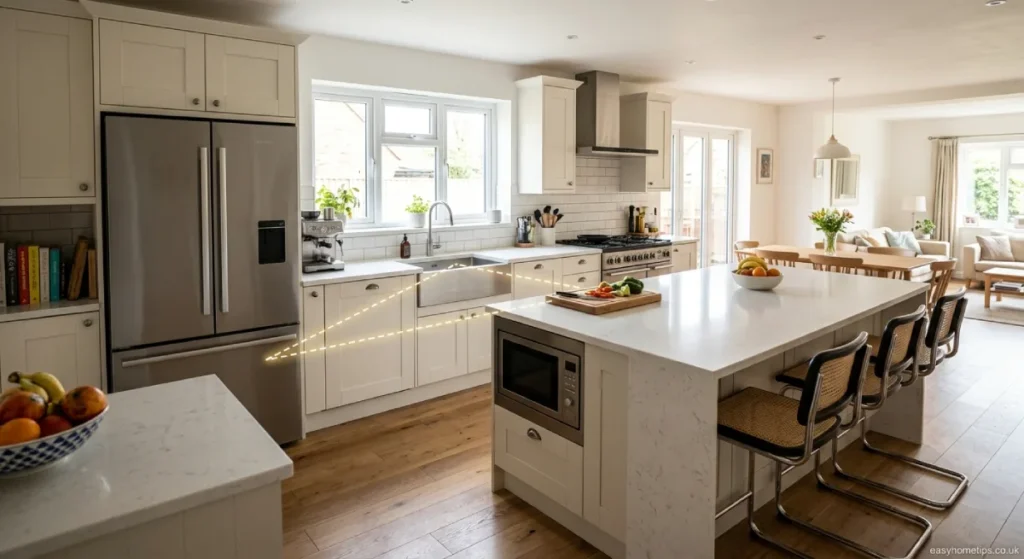
No amount of beautiful finish work can compensate for a poor kitchen layout. This is arguably the most important principle behind timeless kitchen design, and it’s the one most people underestimate because layout changes are expensive.
The classic work triangle — connecting the refrigerator, sink, and range — remains the most functional layout principle in kitchen design. It’s been the industry standard for over 70 years because it mirrors how people actually cook. Modern style kitchen design has evolved this concept into work zones (prep zone, cooking zone, cleanup zone, storage zone), but the core logic is the same.
For kitchen design ideas that age well, prioritize: adequate counter space on both sides of the range, a sink positioned to allow natural light where possible, and enough clearance between islands and cabinets for two people to move comfortably (minimum 42 inches, ideally 48 inches).
One feature that consistently shows up in pictures of kitchens designs that have aged well: an island with seating. It adapts to every life stage — homework for kids, breakfast for adults, entertaining for everyone.
Trick #5: Hardware Is the Jewelry of Your Kitchen — Choose Wisely
Cabinet hardware is small but mighty in timeless kitchen design. The wrong choice can make even beautiful cabinets feel cheap or dated. The right choice elevates everything around it.
The finishes with the longest track record: brushed nickel, oil-rubbed bronze, polished chrome, and unlacquered brass (note: unlacquered, which develops a natural patina over time). Matte black has risen strongly over the past decade and has enough staying power to be considered a long-term safe choice at this point.
The shapes that stand up: simple bar pulls, cup pulls, and classic round knobs. Anything overtly ornamental, overly minimalist, or hyper-specific to a current aesthetic trend carries risk.
One trick professional designers use: mix metals intentionally. A matte black faucet with brushed brass cabinet hardware creates layered warmth that reads as curated rather than mismatched. This is a hallmark of modern style kitchen design done right.
Trick #6: Lighting Should Do Three Jobs at Once
Lighting is the most overlooked element in kitchen design ideas, and getting it wrong is a fast track to a kitchen that feels flat, dated, or dysfunctional.
Timeless kitchen design uses three layers of lighting working together:
Ambient lighting provides overall illumination — typically recessed can lights or a central fixture. These should be on a dimmer. Always.
Task lighting targets work surfaces. Under-cabinet LED strips are the modern standard. They’re functional, unobtrusive, and they never go out of style because they serve a clear purpose.
Accent lighting adds depth and drama. This is where pendant lights over an island come in. When choosing pendants, opt for classic silhouettes: simple glass globes, industrial cage styles, or clean drum shades. These show up in pictures of kitchen designs across decades without feeling out of place.
The hardware finish of your light fixtures should coordinate with — but doesn’t have to match — your cabinet hardware. Cohesion, not uniformity.
Trick #7: Flooring That Adapts to Everything Around It
Kitchen floors take an enormous amount of abuse. Timeless kitchen design demands flooring that’s both durable and versatile enough to work with whatever updates you make down the road.
Hardwood flooring remains the undisputed king of timeless kitchen design. Medium-toned woods in classic species — white oak, walnut, maple — have been used in American homes for generations and show no signs of fading. If you’re concerned about moisture and heavy use, engineered hardwood offers the same aesthetic with improved stability.
Large-format tile (24×24 or larger) in neutral tones is a strong alternative and actually improves with scale — the fewer grout lines, the more polished and current it reads. Subway tile, while wildly popular in modern kitchen design, carries some trend risk due to oversaturation. If you love it, classic white 3×6 subway is a safer bet than trendy colored or unconventional format variations.
What to steer clear of: small mosaic patterns, heavily veined vinyl that looks artificial, and anything that explicitly mimics another material without succeeding at it.
Trick #8: Backsplash — Where You Can Afford to Be Slightly Bolder
Of all the surfaces in a kitchen, the backsplash is the one where timeless kitchen design gives you the most creative latitude. Why? Because backsplashes are relatively affordable to replace compared to countertops or cabinets, so a slightly bolder choice carries less long-term risk.
That said, the most consistently appealing backsplash choices in kitchen ideas images over the decades share common traits: simple patterns, classic materials, and a connection to the overall color palette.
Handmade tile in soft whites or warm neutrals, classic marble slab (running the countertop material up the wall), simple stacked or running bond brick tile — these are choices that show up in pictures of kitchens designs from the 1990s all the way through today without looking out of place.
Where designers push slightly: a single row of decorative tile as a focal point, a warm zellige tile (handmade Moroccan tile with natural variation) in a neutral tone, or a textured concrete tile that adds depth. These read as intentional and artisan rather than trend-chasing.
Trick #9: Edit Ruthlessly — Timeless Kitchens Are Never Cluttered
This final trick isn’t about materials or finishes. It’s about restraint, and it might be the most powerful principle in all of timeless kitchen design.
Every appliance on your counter, every decorative object on your shelves, every magnet on your fridge — they all contribute to a visual noise level. Timeless kitchens feel calm and considered because they’re edited down to what’s essential and beautiful.
Practical steps: invest in appliance garages or dedicated cabinetry to keep small appliances out of sight. Limit open shelving to genuinely curated items — a few beautiful bowls, some cookbooks, a plant. If your kitchen has a window, keep the sill clear to let light in.
The rule professional designers use: for every item you add, ask whether it serves a function, has genuine beauty, or both. If the answer is neither, it doesn’t belong on the counter.
This principle of restraint is what separates a kitchen that photographs well from one that actually lives well — and in timeless kitchen design, both matter equally.
FAQ: Timeless Kitchen Design
Q: Is a modern style kitchen design actually timeless, or will it look dated?
Modern style kitchen design can absolutely be timeless — when it’s executed with restraint. The key is focusing on clean lines, quality materials, and functional layout rather than specific trendy elements. Slab cabinets, integrated appliances, and simple hardware in classic finishes have proven their longevity. What tends to date is hyper-minimalism taken to an extreme (completely handle-less cabinets with push-to-open mechanisms, for example) or finishes that feel cutting-edge rather than quietly refined.
Q: What are the best colors for a timeless kitchen?
The safest palette for timeless kitchen design centers on whites, off-whites, warm creams, and soft greiges for cabinets and walls. For countertops, classic white or cream with natural veining is consistently appealing. If you want to introduce color, do it through paint (which is easy to change), lower cabinets only, or a kitchen island in a contrasting tone like navy, deep green, or charcoal. These colors have decades of proven appeal in kitchen design.
Q: How do I find good kitchen design ideas without just copying trends?
Look at pictures of kitchens designs from 10 to 20 years ago that you still find beautiful today — those are your timeless benchmarks. Study high-end kitchen design from multiple decades and identify what the most consistently appealing spaces have in common (hint: it’s usually simplicity, quality materials, and thoughtful layout). Also look at European and Scandinavian kitchen design traditions, which tend to favor classic restraint over trend-chasing.
Q: Can I have an open kitchen design that’s also timeless?
Yes — open kitchen design has been popular for several decades now and shows no sign of reversing. The key to making it feel timeless rather than of-the-moment is ensuring the kitchen flows naturally into the adjacent living or dining space in terms of color and materials, and that the layout works functionally as a standalone kitchen. An open kitchen that’s only beautiful when empty but chaotic when in use will always feel dated quickly.
Q: Is white kitchen design still timeless in 2025?
Absolutely. White kitchen design has been the dominant choice in American homes for decades, and while it’s had moments of oversaturation, it consistently remains the most versatile, resale-friendly, and adaptable foundation. The key is choosing the right white — warm whites (with cream or gray undertones) tend to feel more timeless than stark bright whites, which can feel clinical.
Conclusion: Your Kitchen Should Outlast the Trends
Here’s the truth about timeless kitchen design: it’s not magic, and it’s not luck. It’s the result of making deliberate choices that prioritize longevity over novelty, quality over flash, and function over form.
The nine tricks in this guide — anchoring with neutrals, choosing proven cabinet styles, investing in quality stone, getting the layout right, selecting durable hardware, layering lighting, choosing adaptable flooring, being smart with your backsplash, and editing ruthlessly — work together as a system. Apply all of them, and you’ll have a kitchen that still turns heads in 2045.
You don’t have to do everything at once. Even if you’re doing a small refresh rather than a full remodel, applying even two or three of these principles will move your kitchen meaningfully toward a more timeless aesthetic.