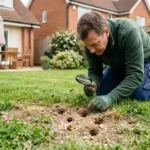





You step outside barefoot, hear a sudden buzz beneath your feet, and then — panic. If you’ve ever discovered a ground bee nest in your lawn, you already know how alarming it can be. Figuring out how to kill ground bees quickly and safely becomes your number-one priority.
The truth is, learning how to get rid of ground bees doesn’t have to be complicated or expensive. With the right approach, you can eliminate a bees nest in the ground on your own, without calling a pest control company. In this guide, you’ll discover 9 powerful, proven hacks to kill ground bees, when to use each method, and how to make sure they never come back.
Whether you’re asking how do you get rid of underground bees for the first time or you’ve battled a ground bee nest before, this article has everything you need to win.
What Are Ground Bees? (And Why You Need to Act Fast)
Before diving into how to kill ground bees, it’s worth knowing exactly what you’re dealing with. “Ground bees” is a general term covering several species — mining bees, sweat bees, digger bees, and yellow jackets — all of which build their nests underground instead of in trees or eaves.
Most solitary ground bees are relatively gentle. They won’t sting unless directly threatened. Yellow jackets, however, are a different story. They’re aggressive, social insects that swarm when their ground bee nest is disturbed. If you’re trying to figure out how do you get rid of underground bees that are acting aggressively, yellow jackets are likely the culprit.
Signs you have a ground bee nest on your property:
- Small piles of loose dirt with a pencil-sized entry hole
- Low-hovering bees circling a specific patch of grass
- Heavy bee traffic in one spot, especially on warm afternoons
Once you spot these signs, it’s time to learn how to kill ground bees before the colony grows larger and harder to manage.
9 Proven Methods to Kill Ground Bees and Eliminate Their Nests
1. Boiling Water — The Fastest Free Method to Kill Ground Bees
One of the most straightforward answers to how to kill ground bees is already in your kitchen. Boiling water poured directly into a ground bee nest kills bees on contact and destroys the tunnel structure instantly. No chemicals, no tools — just heat.
How to do it: Bring a large pot of water to a full boil. Carefully carry it to the ground bee nest and pour it slowly but steadily into the entrance hole. The heat floods the tunnel system and kills ground bees deep inside. Repeat for two to three consecutive nights for complete elimination.
Best for: Small ground bee nests in open lawn areas, away from plant roots and flower beds.
Caution: Boiling water will scorch grass and harm nearby plants. Stick to this method in open soil patches where plant damage isn’t a concern.
This is the most budget-friendly way to eliminate a bees nest in the ground — and it works surprisingly well on smaller colonies.
2. Dish Soap Solution — A Non-Toxic Way to Get Rid of Ground Bees
If you want to know how to get rid of ground bees without pesticides, a simple dish soap and water mixture is one of the most effective natural options. Soap blocks the tiny breathing pores on a bee’s body, called spiracles, causing rapid suffocation.
How to do it: Add two to three tablespoons of liquid dish soap to a garden hose-end sprayer or large spray bottle filled with water. At nightfall, spray or pour the soapy solution directly into the entrance of the ground bee nest. For bigger nests, pour the mixture straight into the hole rather than spraying.
Best for: Families with kids or pets who need a chemical-free way to kill ground bees safely.
This method is especially popular with homeowners who want to know how to get rid of a bees nest using only household products — no trip to the hardware store required.
3. Insecticide Dust — The Most Thorough Way to Eliminate a Ground Bee Nest
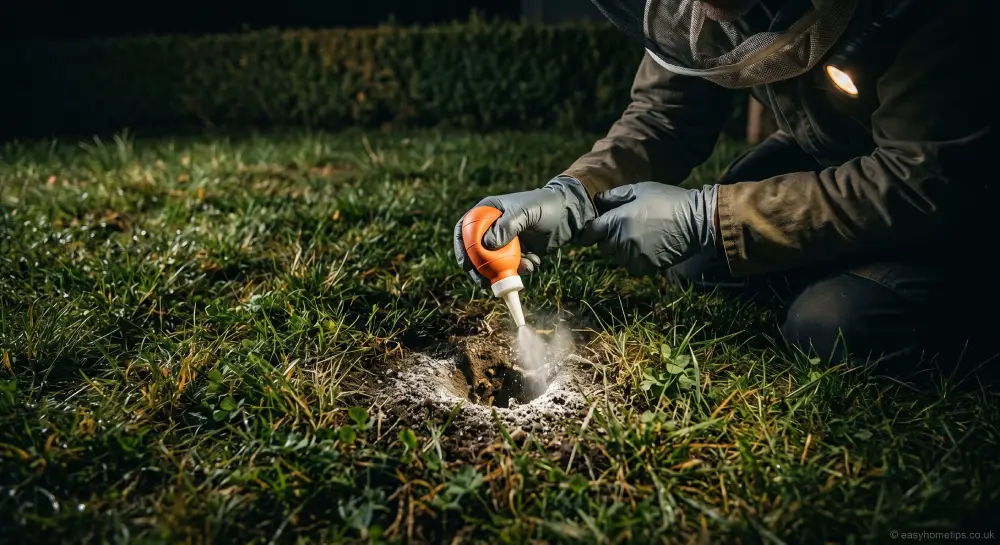
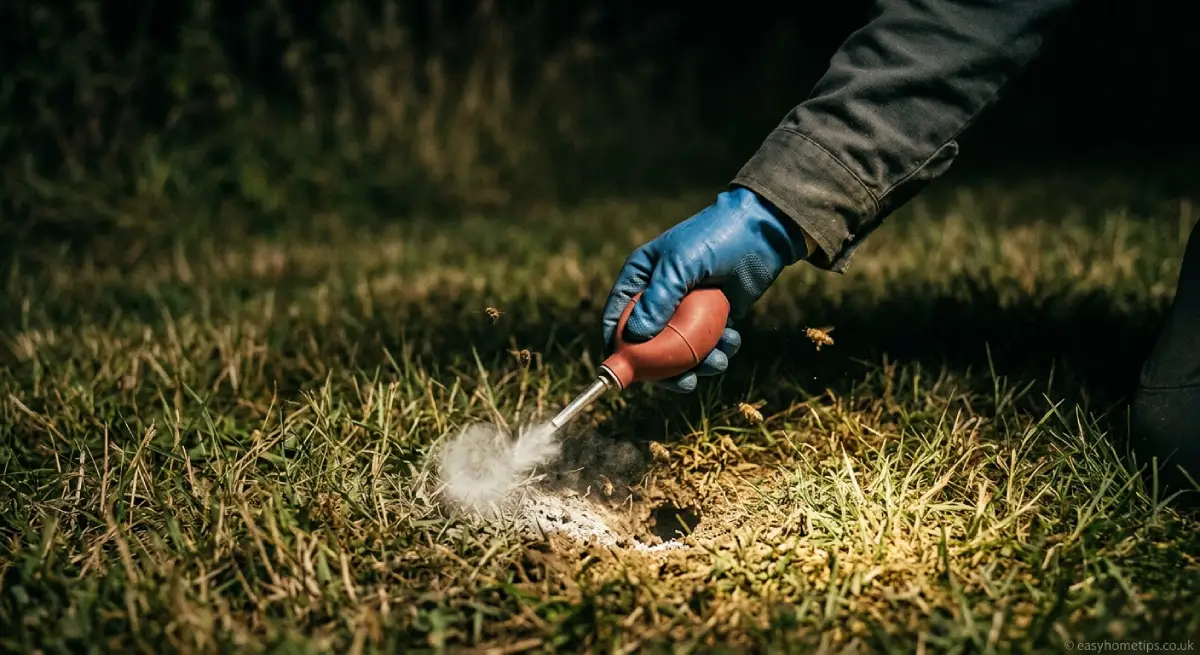
When you need to fully eliminate a bees nest in the ground that’s large or well-established, insecticide dust — brands like Delta Dust or Sevin Dust — is hard to beat. The fine powder sticks to bees as they pass through the tunnel entrance, spreading the insecticide throughout the entire colony over 24 to 48 hours.
How to do it: Put on gloves, long sleeves, and a dust mask. Using a hand duster, lightly puff the insecticide dust into the entrance of the ground bee nest. Don’t seal the hole — you want bees to walk through the treated area. Apply after dark when the colony is fully inside.
Best for: Large, established ground bee nests that haven’t responded to water-based treatments.
Insecticide dust is one of the most complete answers to how to kill ground bees when a natural method hasn’t delivered results. Keep children and pets away from the treated area until the dust fully settles.
4. Pyrethrin Spray — Fast-Acting Liquid Treatment for Underground Bees
Pyrethrin sprays — such as Raid Wasp & Hornet Killer or Hi-Yield 38 Plus — are widely available, affordable, and highly effective at killing ground bees fast. Pyrethrin is derived from chrysanthemum flowers, making it one of the more environmentally friendly chemical options for how to get rid of underground bees.
How to do it: After sunset, insert the spray nozzle directly into the opening of the ground bee nest and release a steady stream into the tunnel. The liquid saturates the passages and kills ground bees on contact. Leave the hole open overnight so returning bees also pick up the insecticide. The next morning, once all activity has stopped, fill the hole with soil.
Best for: Homeowners who want a proven retail product for how to eliminate a bees nest in the ground quickly and reliably.
Pyrethrin is also one of the best answers to how do you get rid of underground bees in situations where other sprays have failed.
5. Garden Hose Flooding — A Chemical-Free Way to Destroy a Ground Bee Nest
Flooding is another effective chemical-free technique for anyone wondering how to get rid of underground bees without insecticides. A sustained flow of water collapses the tunnels, drowns the colony, and makes the site uninhabitable for future nesting.
How to do it: Press the end of a running garden hose firmly into the entrance of the ground bee nest. Let the water flow at full pressure for five to ten minutes. The saturated soil causes the tunnel walls to cave in and drowns any ground bees inside. Repeat for two to three nights.
Best for: Sandy, loose, or dry soil where tunnels are shallow and collapse easily under water pressure.
While this won’t work as a standalone solution for every ground bee nest, it’s an excellent first step — and a great answer to how do you get rid of underground bees on a zero-dollar budget.
6. Diatomaceous Earth — The Slow-Kill Natural Option to Kill Ground Bees
Food-grade diatomaceous earth (DE) is a powder made from fossilized marine organisms. It destroys the outer shell of insects through microscopic abrasion, causing ground bees to dehydrate and die. It’s completely safe for humans and pets — but lethal to any ground bee that crawls through it.
How to do it: Generously dust diatomaceous earth around and directly into the entrance of the ground bee nest. Bees track the powder deep into the tunnel as they enter and exit. Reapply after any rainfall since moisture reduces its effectiveness.
Best for: Garden beds and lawn areas where chemical sprays aren’t practical, and for homeowners who want a lasting natural method to kill ground bees over time.
Diatomaceous earth is also one of the best preventive tools after you’ve successfully eliminated a bees nest in the ground — it discourages re-nesting in the same spot next season.
7. Peppermint Oil — A Natural Repellent to Drive Out Ground Bees
Bees have a strong aversion to the intense scent of peppermint oil. While this won’t instantly kill ground bees in an established colony, it’s very effective at driving out early-stage nests and preventing new ones from forming in your yard.
How to do it: Combine 10 to 15 drops of pure peppermint essential oil with one cup of water in a spray bottle. Shake thoroughly and saturate the soil around and inside the entrance of the ground bee nest. Repeat every day for five to seven days.
Best for: Early spring, when a ground bee nest is just getting started and the colony is still small. Also works as a follow-up treatment to keep ground bees from returning to the same area.
If you’re exploring how to get rid of ground bees without harming the surrounding environment, peppermint oil is one of the most eco-friendly options available.
8. Expanding Foam Spray — Deep Penetration to Eliminate Underground Bee Nests
Commercial expanding foam sprays designed for bees and wasps — like Spectracide Foam or Ortho Home Defense — are excellent for how to get rid of a bees nest that’s deep underground or has a complex tunnel system. The foam expands to fill every chamber and passage, reaching ground bees that liquid sprays simply can’t get to.
How to do it: After dark, press the applicator tip directly into the ground bee nest entrance and release the foam until the hole fills and begins expanding at the surface. The foam hardens over several hours, trapping and killing ground bees inside. Check after 24 hours and reapply if you still notice activity.
Best for: Deep ground bee nests, irregular tunnel systems, and nests located beneath decks, walkways, or other hard-to-access structures.
Foam spray is one of the most complete ways to eliminate a bees nest in the ground when the colony is deep and can’t be reached with powder or liquid treatments alone.
9. Professional Extermination — The Best Option When You Can’t Kill Ground Bees Yourself
Sometimes, no matter how many hacks you try, a ground bee nest is too large, too deep, or too aggressively defended to handle on your own. If repeated treatments haven’t worked, or if the nest is near your home’s foundation, under a patio, or close to a doorway, it’s time to call in a professional.
A licensed pest control technician knows exactly how to kill ground bees of every species using industrial-grade products and equipment. They can identify whether you’re dealing with solitary ground bees or the far more dangerous yellow jackets and tailor their treatment accordingly.
Best for: Large yellow jacket colonies, nests in wall voids or near foundations, households with members allergic to bee stings, and any situation where repeated DIY efforts to get rid of ground bees have failed.
Professional extermination guarantees that the entire ground bee nest — from entrance to deepest chamber — is completely and permanently eliminated.
When Is the Best Time to Kill Ground Bees?
Timing is everything when figuring out how to kill ground bees effectively. Here’s how to maximize your results every single time:
Treat at night. This is the single most important rule. Ground bees are inside their nest after dark, which means your treatment reaches the maximum number of bees at once. You also dramatically reduce your own risk of getting stung. Whether you’re using boiling water, insecticide dust, or foam spray, always treat the ground bee nest after sunset.
Act early in the season. Ground bee colonies are at their smallest and weakest in early spring. Treating a ground bee nest early — before the population peaks — makes elimination far easier and faster. Waiting until midsummer means dealing with a much larger, more defensive colony.
Avoid windy evenings. Wind carries insecticide dust and sprays away from the target area, reduces treatment effectiveness, and increases the chance of accidental exposure to plants, water sources, or neighboring properties.
How to Prevent Ground Bees From Coming Back
Knowing how to kill ground bees solves today’s problem. Preventing re-infestation solves it permanently. Here’s how to make your yard less attractive to ground bees year after year:
Maintain a thick, dense lawn. Ground bees prefer to nest in dry, sparse, or bare soil. A thick, full lawn gives them nowhere to dig. Overseed thin and patchy areas every fall to close off the gaps that invite a new ground bee nest to form.
Lay down mulch over bare soil. Covering exposed garden beds and bare ground with three to four inches of wood chip mulch blocks ground bees from establishing new nests. This is one of the most effective long-term strategies for how to get rid of ground bees permanently.
Keep your lawn consistently moist. Ground bees strongly prefer dry soil. Regular, deep watering — especially in late spring when queen bees scout for nest sites — makes your yard far less hospitable and is one of the simplest deterrents for how to get rid of underground bees naturally.
Apply diatomaceous earth as a preventive barrier. After you eliminate a ground bee nest, dust the area with DE. Any scout bees that return to investigate will contact the powder and be deterred or killed before a new colony gets established.
FAQ: How to Kill Ground Bees and Get Rid of Them for Good
Q: What is the fastest way to kill ground bees? The fastest methods to kill ground bees are pyrethrin spray and expanding foam — both work within 24 to 48 hours when applied directly into the ground bee nest at night. Insecticide dust is slightly slower but often more thorough for completely eliminating a large, deep colony.
Q: Are ground bees dangerous? Most ground bee species are solitary and rarely sting unless stepped on or their nest is directly disturbed. Yellow jackets, however, which also build nests underground, are aggressive and will sting repeatedly when their ground bee nest is threatened. If bees swarm at you when you approach the hole, treat the situation as a yellow jacket infestation and consider calling a professional.
Q: How do I tell the difference between ground bees and yellow jackets? Ground bees are typically fuzzy and round-bodied, much like a honeybee. Yellow jackets are sleek, smooth, and distinctly yellow-and-black with a narrow waist. Yellow jacket nests also have much heavier traffic and are far more defensive when disturbed. Observe from a safe distance before attempting to kill ground bees yourself.
Q: How long does it take to fully eliminate a ground bee nest? Most methods to kill ground bees take two to five days of consistent treatment to fully eliminate the colony. Foam and pyrethrin sprays show results within 24 to 48 hours. Natural methods like boiling water and dish soap may need three to five applications. Large nests treated with insecticide dust are typically eliminated within three to four days.
Q: Will ground bees come back to the same spot next year? Yes — scout bees return to locations where colonies have nested successfully before. After you eliminate a bees nest in the ground, follow up with preventive measures: lay mulch, water the area regularly, reseed bare lawn patches, and apply diatomaceous earth to keep ground bees from re-establishing in the same spot next season.
Conclusion: Start Tonight and Take Back Your Yard
Now you know exactly how to kill ground bees using nine proven, practical methods — from boiling water and dish soap to insecticide dust, pyrethrin spray, foam, and professional extermination. Every approach to kill ground bees has its place, depending on the size of your ground bee nest, the species involved, and how fast you need results.
The formula is simple: treat the ground bee nest at night, stay consistent with follow-up applications, and take preventive steps once the colony is gone. Whether you go natural or chemical, the goal is the same — eliminate a bees nest in the ground completely and get rid of ground bees for good.
Don’t wait. The longer a ground bee nest goes untreated, the larger and harder to manage the colony becomes. Pick the method that fits your situation and take action tonight. Your lawn — and your peace of mind — will thank you.
Still dealing with a stubborn ground bee nest? Drop your question in the comments. We’ll help you find the best way to get rid of ground bees once and for all.
Safety Reminder: Always wear protective clothing — long sleeves, gloves, and eye protection — when treating any ground bee nest. If you suspect yellow jackets, or if anyone in your home has a known allergy to bee stings, contact a licensed pest control professional before attempting any DIY treatment to kill ground bees.